The protocol underneath African language AI.
A tokenizer that cuts the token premium, a consented recordings network and the app members record with.

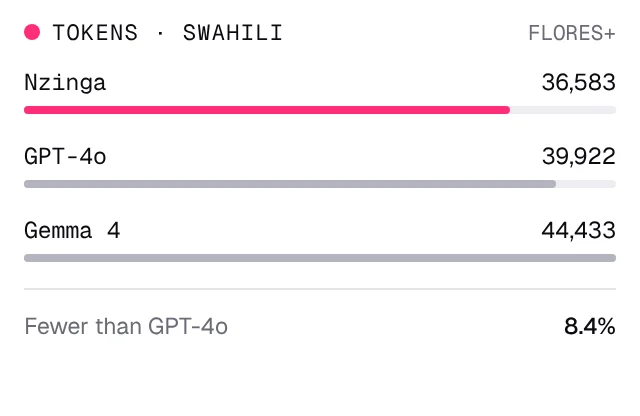
FLORES+ · SWAHILI
1.35x
▼ 8.4% vs GPT-4o



Recording a Swahili note
0:42

Your choice
SWAHILI
✓
Only me
Not paid
✓
Nzinga's models
Paid
✓
Nzinga and approved partners
Paid + share
Everyone
Paid
Works with, measured on and released through
Gemma 3
Llama 3.1
FLORES+
NTREX-128
Hugging Face
Expo
WHY NZINGA
For the same meaning, African languages need more tokens than English.Nzinga cuts that premium at the tokenizer, then builds the data to go further: recordings members choose to share, paid for every accepted minute.
Three products built on one protocol.
A tokenizer, a consented network and a phone app. Every recording keeps its speaker's choice from start to end.


Nzinga Tokenizer
Fewer tokens for African languages.
32,000 African word pieces added to Gemma 3's tokenizer. Every existing token keeps its ID, so English and French barely change.

Cost
At any per-token price, fewer tokens cost less per query.

Context
More African-language text fits in the same window.

Speed
Fewer tokens to generate, so replies come back sooner.

Swahili
A 128,000-token window reads 79,100 words of Swahili, against 71,900.

Raw tokens
Counted on the same sentences, against twelve other tokenizers, never on premiums alone.
Held-out
No test sentence shares a 13-word sequence with any of the training text.

Per-speaker consent
Every voice in a recording makes its own choice.
Withdrawal
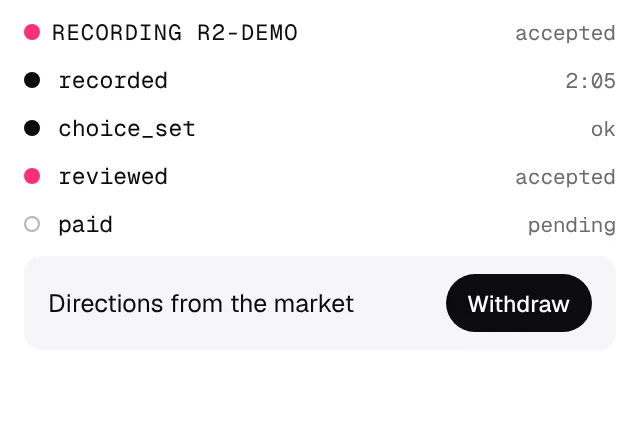
Withdraw any recording from its own page, at any time.
Nzinga Network
Recordings that stay with their speakers.
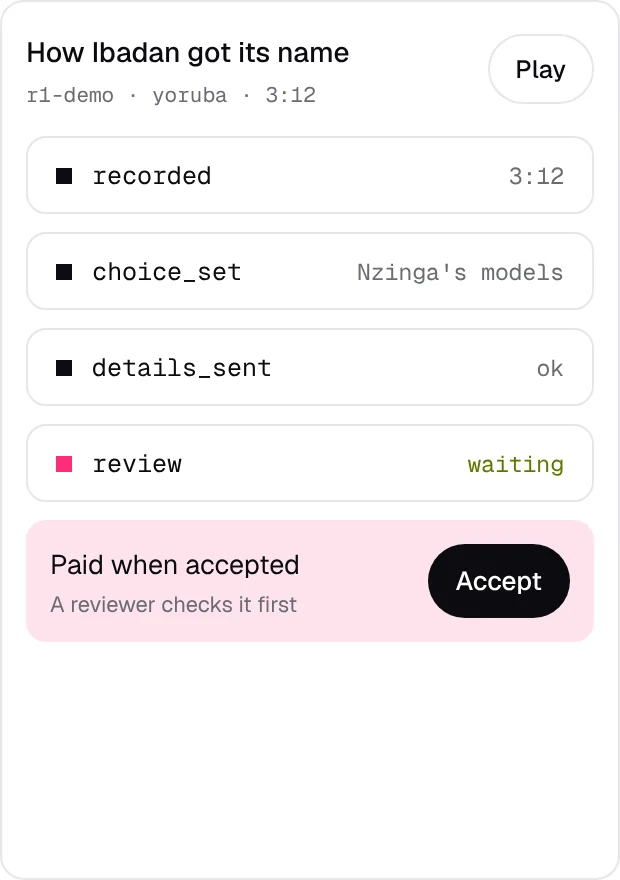
Invite-only membership, a choice on every recording, pay per accepted minute and hashed contacts.

Invites
Three invites to start, and one more per accepted hour.

Pay
Paid per accepted minute, with a share of licensing revenue.

Contacts
Numbers scrambled on the phone; Nzinga keeps none of them.

Demo app
Opens in Expo Go: any number, code 482917, any invite code.
Or build on the API directly.
1
import{ createLiveClient } from"./lib/api";
2
3
constapi = awaitcreateLiveClient(() => session.token);
4
5
constrec = awaitapi.createRecording({
6
kind: "voice_note",
7
language: "swh",
8
speakers: ["m_9f2c", "m_41ab"],
9
durationSeconds: 192,
10
});
11
12
for await(const r of (await api.myRecordings()).recordings) {
13
console.log(r.language, r.status);
14
}
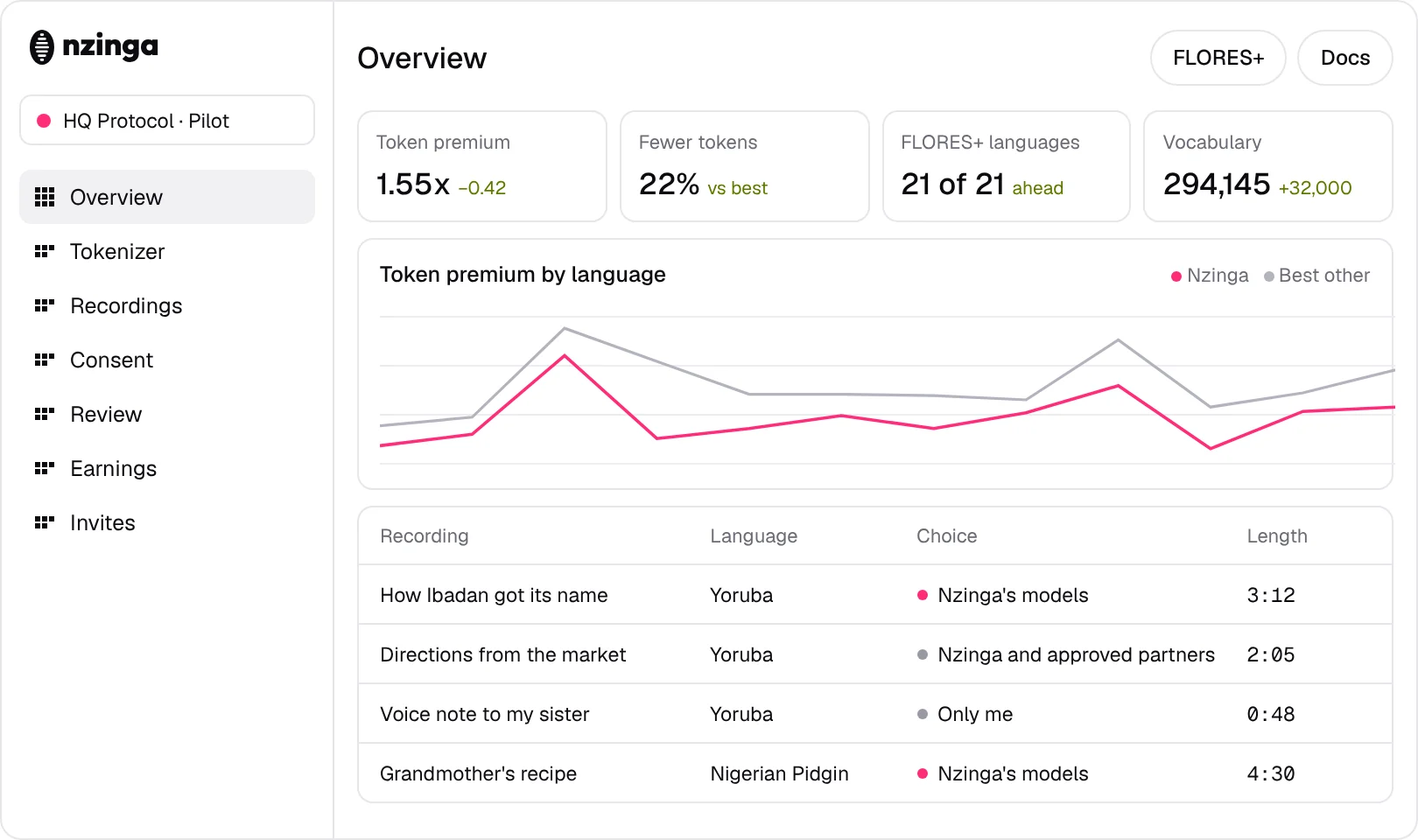
294,145
tokens in the vocabulary
1.55x
average Tier 1 token premium
21 of 21
languages ahead on FLORES+
Languages that cost less on Nzinga.

Consent you can check yourself.
Every consent names the exact text shown, by version and hash. Records are never edited, so history stays.
SHA-256 CONSENT HASH
APPEND-ONLY RECORDS
PER-SPEAKER
WITHDRAWABLE

Speakers
Each voice in a recording chooses for itself.
Hashed contacts
Numbers scrambled on the phone, never stored.

Versioned
Consent names its text by version and hash.

Invites
Members join only with an invite code.

Withdrawal
Withdraw any recording, or everything, any time.

Your choice
“Only me” never trains any model.
Pay that follows each minute you share.
Members
Paid
For every accepted minute
- Rate set at launch
- Your voice only
- Three invites
- Mobile money
Licensing
Nzinga and approved partners
Share
/ licence
Licensing revenue, shared
- Paid per minute, plus share
- Accepted seconds count
- Approved partners
- Withdraw at any time
Partners
Licence
Partner licensing, terms on request
- Only consented, accepted recordings
- Every speaker's choice checked
- Language datasets
- Revenue shared
Rates are set per market at launch. Members keep what they are paid, even after withdrawing.
Questions, answered.
The docs go deeper, or write to the team.
Who decides how my recordings are used?
You do, recording by recording: “Only me”, “Nzinga's models”, “Nzinga and approved partners” or “Everyone”. You can change or withdraw it any time.
Which models use the tokenizer?
Gemma 3 models today, and Llama 3.1 through a separate pack.
What counts as an accepted minute?
Each minute of your own voice that a reviewer accepts. Every choice except “Only me” is paid.
Can I withdraw a recording later?
Yes, any time. It leaves all future training and licensing. You keep what you were paid.
What happens to the contacts on my phone?
Each number is scrambled on your phone first. Nzinga keeps none of the codes.
How do I join Nzinga?
With an invite code from a member. The demo opens in Expo Go with code 482917.

Try it in your language.
Paste a sentence and see the tokens it needs.